1 USD to PKR in 1947 – Pakistan’s First Dollar Exchange Rate
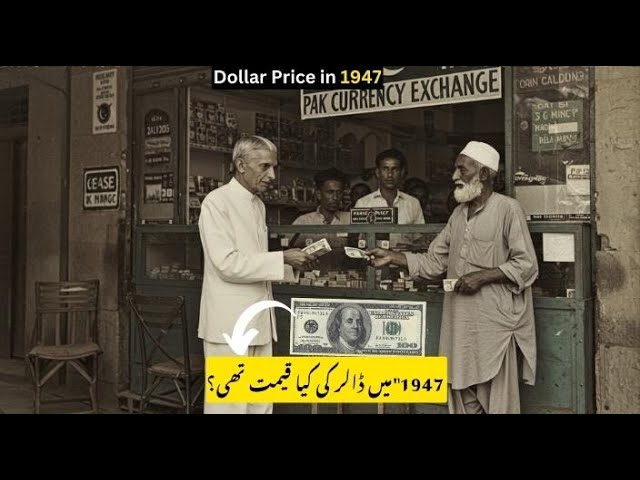
When Pakistan became independent in August 1947, it inherited a fragile but structured financial system. One of the most important economic indicators at that time was the exchange rate between the US Dollar (USD) and the Pakistani Rupee (PKR). This rate reflected the country’s financial position in the global system.
Today in 2026, the dollar trades above Rs. 280 in the open market. This huge difference naturally raises curiosity about what the original rate was and how it changed over time.
Dollar Rate at Independence (1947)
At the time of independence:
1 USD ≈ 3.31 PKR
This means one US dollar was equal to just over three rupees.

Compared to today’s rate, the rupee appears extremely strong in 1947. However, the global and domestic economic systems were very different at that time.
Why Was the Dollar So Low in 1947?
Several important reasons explain this:
1️⃣ Controlled and Small Economy
In 1947:

- Agriculture was the main economic activity.
- Industrial production was limited.
- Imports and exports were small in scale.
- International travel and foreign investment were rare.
Because Pakistan had limited trade activity, the demand for US dollars was low. Lower demand for foreign currency helped keep the rupee stable.
2️⃣ Fixed Exchange Rate System
At independence, Pakistan followed the global Bretton Woods system. Under this structure:
- The rupee was linked to the British pound.
- The pound was indirectly tied to the US dollar.
- The US dollar was backed by gold.
This fixed system reduced sudden currency fluctuations. Exchange rates were managed by policy, not by open market supply and demand.

The State Bank of Pakistan was established in 1948 to regulate currency and monetary policy.
3️⃣ Low Inflation
In the early years:
- Prices were relatively stable.
- Inflation was moderate.
- Purchasing power remained steady.
Stable inflation usually supports a strong currency.
4️⃣ Limited Global Exposure
During the late 1940s:
- Overseas employment was uncommon.
- Tourism was minimal.
- Foreign companies had little presence.
- Global trade participation was small.
With fewer international transactions, pressure on the rupee remained limited.

Exchange Rate Journey: 1947–2026
Below is a simplified overview of how the dollar rate changed over time:
| Year | 1 USD = PKR | Situation |
|---|---|---|
| 1947 | 3.31 | Independence, fixed system |
| 1955 | 4.76 | First devaluation |
| 1972 | 9.90 | Shift toward flexible system |
| 1990 | 21.71 | Rising debt and inflation |
| 2000 | 51.90 | Economic reforms |
| 2010 | 85+ | External imbalance |
| 2020 | 160+ | Persistent depreciation |
| 2026 | 280+ | Market-based rate |
The pattern shows gradual weakening over decades rather than a sudden collapse.
Major Turning Points
🔹 1950s – First Devaluation
In 1955, Pakistan officially adjusted the exchange rate to around Rs. 4.76 per dollar due to trade pressures.
🔹 1970s – Structural Changes
After the 1971 war and global oil crisis, the exchange rate system became more flexible. By 1972, the dollar was close to Rs. 10.
🔹 1980s–1990s – Debt and Inflation
Higher borrowing, growing imports, and rising inflation pushed the dollar beyond Rs. 20 by 1990.
🔹 2000s–2020s – Market-Based System
With increased global integration, trade deficits, and economic pressures, the rupee continued to weaken. By the 2020s, the dollar crossed Rs. 280.
Why Did the Rupee Weaken Over Time?
The shift from Rs. 3.31 to over Rs. 280 did not happen overnight. Several long-term factors played a role:
- Continuous inflation
- Higher imports than exports
- Rising foreign debt
- Global financial shocks
- Political and economic uncertainty
- Transition from fixed to floating exchange rate
In a floating system, exchange rates respond to supply and demand rather than strict government control.
1947 vs 2026 – A Big Difference
- 1947: 1 USD ≈ Rs. 3.31
- 2026: 1 USD ≈ Rs. 280+
This change reflects decades of economic growth, structural reforms, global integration, inflation trends, and financial challenges.
Final Thoughts
The dollar rate of Rs. 3.31 in 1947 represents a very different economic era — one with limited global trade, controlled exchange systems, and lower financial complexity.
The journey from 1947 to 2026 mirrors Pakistan’s broader economic evolution. The rise in the dollar rate is not the result of a single event but the combined outcome of nearly 80 years of economic developments, reforms, and global changes.