1 USD to PKR in 1947 vs 2026 A Shocking Journey of Pakistan Rupee You Must See
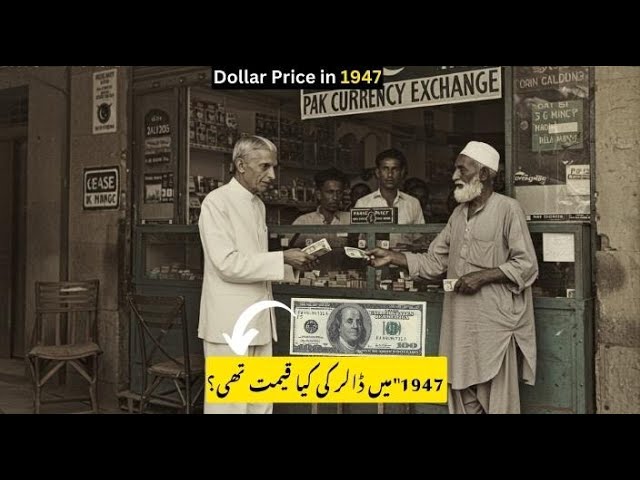
The exchange rate between the US Dollar (USD) and Pakistani Rupee (PKR) is a key sign of a country’s economic health. It tells us how strong or weak a currency is compared to the global market. When Pakistan became independent in 1947, its currency was much stronger than it is today.
Over time, the value of the rupee changed بسبب factors like inflation, trade, and economic policies. Today in 2026, the dollar rate has crossed around 280 rupees, which is a huge difference compared to the early years.
Dollar Rate in 1947
At the time of independence, the exchange rate was approximately:
1 USD = 3.31 PKR

This means one US dollar was equal to just a little more than three rupees. Compared to today, this shows that the rupee was very strong in the beginning.
However, the economic system at that time was very different from today. Pakistan had limited trade, fewer industries, and less global connection.
Why Was the Dollar Rate So Low in 1947?
There were several reasons why the dollar rate remained low in the early years of Pakistan.

| Factor | Explanation |
|---|---|
| Small Economy | Pakistan’s economy was mostly based on agriculture |
| Low Trade | Imports and exports were limited |
| Limited Investment | Few foreign companies were working in Pakistan |
| Controlled System | Currency rates were fixed by government policies |
Because there was less demand for dollars, the rupee stayed stable and strong.
Economic Structure in Early Years
Pakistan’s economy in the late 1940s was simple and less developed compared to today.
Some key features were:
- Agriculture was the main sector
- Industrial growth was very slow
- Very little international travel
- Limited connection with global markets
Due to these reasons, the demand for foreign currency remained low.
Fixed Exchange Rate System
At that time, Pakistan followed a fixed exchange rate system under the global Bretton Woods system.
This system worked like this:
| Currency Link | Description |
| Pakistani Rupee | Linked with British Pound |
| British Pound | Connected to US Dollar |
| US Dollar | Backed by gold reserves |
This system did not allow sudden changes in currency value. Governments controlled exchange rates instead of market forces.
Pakistan also established the State Bank of Pakistan in 1948 to manage currency and financial systems.

Inflation and Stability in Early Years
In the early years:
- Inflation was low
- Prices were stable
- Government spending was controlled
- Purchasing power of rupee was strong
Low inflation helped maintain the strength of the rupee.
How the Dollar Rate Changed Over Time
Over the decades, the value of the rupee started decreasing. This did not happen suddenly but gradually due to economic pressures.
| Year | USD to PKR | Situation |
| 1947 | 3.31 | Independence and stable system |
| 1955 | 4.76 | First devaluation |
| 1972 | 9.90 | Economic changes |
| 1990 | 21.71 | Inflation and debt increase |
| 2000 | 51.90 | Economic reforms |
| 2010 | 85+ | Trade imbalance |
| 2020 | 160+ | Currency pressure |
| 2026 | 280+ | Market-based system |
This table shows how the rupee weakened step by step over time.
Major Turning Points
There were some important periods that changed the exchange rate.

In the 1950s, Pakistan faced trade problems and had to devalue its currency.
In the 1970s, political and economic challenges, including war and oil crisis, affected the economy.
In the 1980s and 1990s, foreign debt increased and inflation became higher.
From 2000 onward, Pakistan moved toward a market-based exchange system where demand and supply decide the rate.
Why the Rupee Became Weaker
There are several long-term reasons behind the increase in dollar rate.

- Continuous inflation over many years
- More imports than exports
- Rising foreign debt
- Economic instability
- Global financial pressures
- Shift from fixed to floating exchange system
In a floating system, currency value depends on market conditions instead of government control.
Comparison Between 1947 and 2026
| Year | Dollar Rate | Economic Condition |
| 1947 | 1 USD ≈ 3.31 PKR | Controlled and simple economy |
| 2026 | 1 USD ≈ 280+ PKR | Global and complex economy |
This comparison clearly shows how much the economy has changed over time.
Simple Summary
Let’s make it easy to understand:
- In 1947, the dollar was very cheap
- Today, the dollar is very expensive
- The rupee became weaker slowly over time
- Many economic factors caused this change
- It is a long-term process, not a sudden event
Final Thoughts
The journey from 1 USD = 3.31 PKR in 1947 to over 280 PKR in 2026 tells the story of Pakistan’s economic changes. In the early years, the country had a stable and controlled system with limited global interaction. Over time, inflation, trade, and financial challenges affected the value of the rupee.
This change is not due to one single reason but a combination of many factors over decades. Understanding this history helps us better understand Pakistan’s economy today.