1 USD to PKR in 1947 – Complete Historical Exchange Rate of US Dollar in Pakistan
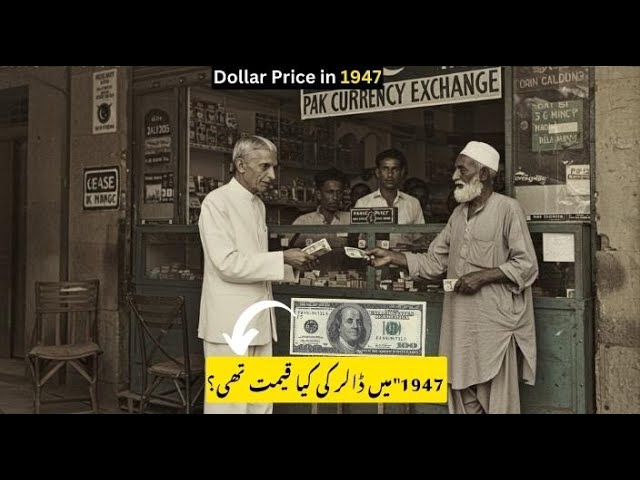
When Pakistan became an independent country in August 1947, it entered the world with a newly formed economy and a developing financial system. One of the most important economic indicators at that time was the exchange rate between the US Dollar (USD) and the Pakistani Rupee (PKR).
Today, the dollar trades at hundreds of rupees. But in 1947, the situation was very different.
Historical Exchange Rate in 1947
In 1947:
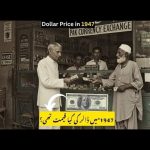
1 USD = approximately 3.31 PKR

This means that one US dollar was equal to just over three Pakistani rupees.
At first glance, this number seems extremely low compared to modern exchange rates. However, to understand it properly, we must look at the economic conditions of that time.
Selected Historical USD to PKR Exchange Rates
Here is a simplified overview of how the dollar rate changed over time:

| Year | 1 USD = PKR | Key Context |
|---|---|---|
| 1947 | 3.31 | Independence year; rupee strong |
| 1955 | 4.76 | First official devaluation |
| 1972 | 9.90 | Rupee floated after 1971 war |
| 1990 | 21.71 | Economic reforms period |
| 2000 | 51.90 | Inflation and policy shifts |
| 2010 | 85.50 | Global and domestic pressure |
| 2020 | 160.50 | Continued depreciation |
| 2025 | ~283.35 | Long-term decline visible |
This table shows how dramatically the rupee’s value changed over nearly eight decades.
Why Was the Dollar Rate So Low in 1947?
The 1947 exchange rate of Rs. 3.31 per dollar was not random. Several important factors kept the rupee strong at that time.
1️⃣ A Newly Established Economy
In 1947:

- Pakistan’s economy was small.
- Industrial activity was limited.
- Foreign trade volume was low.
- Most people worked in agriculture.
Because international trade and foreign investment were minimal, demand for US dollars was also limited. Lower demand for foreign currency helped maintain a stable exchange rate.
2️⃣ Fixed Exchange Rate System (Bretton Woods Era)
At independence, Pakistan followed a fixed exchange rate system.
- The rupee was linked to the British pound sterling.
- The pound was indirectly connected to the US dollar.
- The US dollar itself was tied to gold under the Bretton Woods system.
This global system kept exchange rates stable and prevented large fluctuations. Currency values were controlled by policy rather than market forces.
3️⃣ Low Inflation
In the early years after independence:
- Prices of goods were low.
- Inflation was moderate.
- Purchasing power of the rupee was strong.
When domestic prices remain stable, the currency tends to retain value relative to foreign currencies.

4️⃣ Limited Foreign Exchange Demand
In 1947:
- International travel was rare.
- Foreign education was limited.
- Overseas investment was small.
Most trade transactions were controlled and regulated. As a result, the demand for US dollars remained low, supporting the rupee’s strength.
How the Dollar Rate Changed Over Time
The journey from Rs. 3.31 in 1947 to over Rs. 280 in the mid-2020s reflects Pakistan’s economic evolution.
1950s – First Devaluation
By the mid-1950s, Pakistan began:
- Borrowing from international institutions
- Expanding trade
- Encouraging exports
To support exports and adjust to economic realities, the government officially devalued the rupee.
The rate increased to around Rs. 4.76 per dollar.
This was the first major shift in exchange rate policy.
1970s – Structural Changes
The early 1970s were a turning point:
- Separation of East Pakistan (1971)
- Economic restructuring
- Global oil crisis
During this period, Pakistan moved toward a more flexible exchange rate system. The rupee was allowed to float more freely.
By 1972, the dollar rate reached nearly Rs. 10 per dollar.

1980s and 1990s – Inflation and Liberalization
During these decades:
- Inflation increased.
- External debt rose.
- Structural adjustment programs were introduced.
- Foreign currency demand grew.
By 1990, the exchange rate crossed Rs. 20 per dollar.
The rupee continued weakening as Pakistan integrated more into the global economy.
2000s – Accelerated Depreciation
In the 21st century, new challenges emerged:
- Global financial crises
- Political instability
- Energy shortages
- Trade deficits
By 2010, the dollar rate had crossed Rs. 85.
By 2020, it exceeded Rs. 160.
By the mid-2020s, it moved beyond Rs. 280 per dollar.
Why Did the Rupee Depreciate Over Time?
Several long-term economic factors explain the decline from Rs. 3.31 to over Rs. 280.
✔ Inflation
Over decades, Pakistan experienced repeated inflationary cycles. Inflation reduces purchasing power, weakening the currency.
✔ Trade Deficits
Pakistan has often imported more than it exported. When imports exceed exports, demand for foreign currency rises, weakening the local currency.
✔ External Debt
Government borrowing from international lenders increased foreign exchange obligations, putting pressure on the rupee.
✔ Political and Economic Instability
Wars, regime changes, and policy uncertainty affected investor confidence and economic stability.
✔ Market-Based Exchange System
Unlike 1947, today’s exchange rate is largely market-driven. It changes based on supply and demand rather than fixed government control.
Economic Meaning of the 1947 Rate
The 1947 exchange rate of Rs. 3.31 per dollar represents:
- A tightly controlled currency system
- Low foreign exchange demand
- Limited global integration
- Strong purchasing power of the rupee
It reflects a completely different economic era.
Final Comparison
- 1947: 1 USD ≈ Rs. 3.31
- Mid-2020s: 1 USD ≈ Rs. 280+
This change is not just about numbers. It tells the story of:
- Inflation
- Economic transformation
- Global integration
- Structural challenges
Conclusion
The exchange rate of 1 USD to PKR in 1947, at around Rs. 3.31, represents a time when Pakistan’s economy was young, stable, and operating under a fixed global monetary system.
Over the next 78 years, economic growth, inflation, trade imbalances, policy decisions, and global financial changes dramatically altered the value of the rupee.