1 USD to PKR in 1947 – The First Dollar Rate in Pakistan’s History
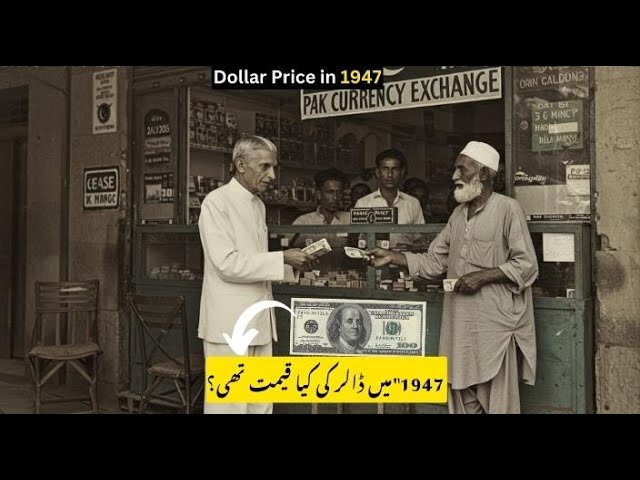
When Pakistan emerged as an independent state in August 1947, it stepped into the world with a newly formed but delicate economic structure. Among the key financial benchmarks of that time was the exchange rate between the US Dollar (USD) and the Pakistani Rupee (PKR), which reflected the country’s monetary strength and global positioning.
Fast forward to 2026, the US dollar trades above Rs. 280 in the open market. This sharp contrast naturally raises an important question: how did the rupee move from being relatively strong in 1947 to its current level?
This article presents a completely original and detailed review of the USD to PKR exchange rate journey from independence to 2026, along with the economic forces behind its long-term shift.
Exchange Rate at Independence (1947)
At the time of independence:

1 USD ≈ 3.31 PKR
In simple terms, one US dollar was worth slightly more than three Pakistani rupees.
Compared to today’s rate, this figure appears extremely low. However, the economic environment of 1947 was entirely different from the globalized, market-driven world we live in now.
Why Was the Dollar So Cheap in 1947?
Several structural and global factors explain why the rupee held stronger value during Pakistan’s early years.
1. A Smaller, Controlled Economy
In 1947, Pakistan’s economy had limited scale and global exposure:
- Agriculture dominated national income.
- Industrial output was minimal.
- International trade volumes were relatively low.
- Foreign investment was rare.
- Overseas employment and travel were uncommon.
Since imports were limited and international transactions were few, the demand for US dollars remained low. When demand for foreign currency is limited, local currency tends to remain stable.

2. Fixed Exchange Rate Under the Bretton Woods System
At independence, Pakistan followed the global Bretton Woods monetary framework.
Under this system:
- The rupee was pegged to the British pound.
- The British pound was indirectly connected to the US dollar.
- The US dollar was backed by gold reserves.
This arrangement reduced exchange rate volatility and prevented sudden fluctuations. Unlike today’s floating exchange system, currency values were determined by official policy rather than open market demand.
Pakistan’s central banking system was later formally organized under the State Bank of Pakistan, established in 1948 to regulate monetary policy and currency management.
3. Low Inflation in Early Years
During the initial decades after independence:

- Consumer prices were relatively stable.
- Inflation was moderate.
- Domestic purchasing power remained strong.
Stable inflation typically supports currency value. Since Pakistan did not experience persistent high inflation in its early years, the rupee maintained relative stability.
4. Limited Global Integration
In the late 1940s:
- International education was uncommon.
- Migration for employment was limited.
- Tourism was minimal.
- Foreign corporate presence was small.
Because Pakistan was not deeply integrated into the global financial system, the demand for foreign currency remained naturally controlled.
Exchange Rate Evolution: 1947–2026
Below is a simplified overview of major exchange rate milestones over the decades:
| Year | 1 USD = PKR | Economic Context |
|---|---|---|
| 1947 | 3.31 | Independence; fixed system |
| 1955 | 4.76 | First devaluation |
| 1972 | 9.90 | Post-war restructuring; flexible shift |
| 1990 | 21.71 | Debt expansion period |
| 2000 | 51.90 | Structural reforms, inflation |
| 2010 | 85.50 | Growing external imbalance |
| 2020 | 160+ | Persistent depreciation |
| 2025 | ~283 | Inflation and reserve pressure |
| 2026 | ~280+ | Market-driven rate |
The long-term pattern clearly shows gradual depreciation rather than sudden collapse.
Key Phases of Currency Movement
1950s: First Official Devaluation
By the mid-1950s:
- Trade activity increased.
- Export competitiveness became a concern.
- Foreign borrowing began to rise.
In 1955, the government officially adjusted the exchange rate from 3.31 to approximately 4.76 per dollar. This marked Pakistan’s first major currency correction.
1970s: Political and Structural Shifts
The early 1970s significantly reshaped the economy due to:
- The 1971 war and separation of East Pakistan.
- Global oil price shocks.
- Policy restructuring.
The exchange system became more flexible, and by 1972, the dollar approached Rs. 10. This era marked the beginning of a more market-responsive currency framework.
1980s–1990s: Inflation and External Debt
During these decades:

- Inflation steadily increased.
- External debt expanded.
- Structural adjustment programs were introduced.
- Imports grew faster than exports.
By 1990, the dollar crossed Rs. 20. The rupee’s weakening trend became more noticeable as economic pressures intensified.
2000s: Rapid Depreciation Phase
In the 21st century, new economic pressures emerged:
- Rising trade deficits
- Political uncertainty
- Energy shortages
- Global financial instability
By 2010, the exchange rate exceeded Rs. 85 per dollar.
By 2020, it crossed Rs. 160.
The depreciation became more persistent rather than temporary.
2020s: Fully Market-Based Exchange Rate
In recent years:

- The rate crossed Rs. 280 per dollar.
- Foreign exchange reserves fluctuated.
- Inflation remained elevated.
- Import payments increased significantly.
Today’s exchange rate is largely determined by supply and demand in the open market rather than strict government control.
Why Did the Rupee Gradually Weaken?
The transition from Rs. 3.31 in 1947 to over Rs. 280 in 2026 reflects long-term economic dynamics rather than a single event.
Inflation
Over decades, continuous price increases reduced purchasing power. When domestic inflation remains higher than that of trading partners, currency depreciation often follows.
Trade Imbalance
Pakistan has frequently imported more goods than it exported. A higher demand for dollars to pay for imports places pressure on the rupee.
External Borrowing
Foreign loans must be repaid in dollars. Rising debt obligations increase demand for foreign currency.

Political and Economic Uncertainty
Policy instability, regional conflicts, and reform programs affected investor confidence and capital flows.
Shift to Floating Exchange System
Unlike the fixed system of 1947, today’s exchange rate reacts to:
- Foreign reserves
- Investor confidence
- Export performance
- Global market conditions
This flexibility allows natural adjustments but also exposes the currency to volatility.
What the 1947 Rate Symbolizes
The Rs. 3.31 exchange rate represents:
- A smaller domestic economy
- Limited global trade exposure
- Stable international monetary arrangements
- Controlled financial systems
It reflects a different economic era — one that operated under strict regulation and limited global integration.

1947 vs 2026: A Perspective
- 1947: 1 USD ≈ Rs. 3.31
- 2026: 1 USD ≈ Rs. 280+
This difference is not merely numerical. It reflects decades of:
- Economic growth and expansion
- Structural reforms
- Global market integration
- Inflationary trends
- Policy transformations
Conclusion
The USD to PKR exchange rate journey from 1947 to 2026 mirrors Pakistan’s broader economic story. From a newly independent nation operating under a fixed global system to a developing economy integrated into international markets, the rupee’s movement reflects both progress and challenges.
The shift from Rs. 3.31 to over Rs. 280 per dollar is not a sudden event but the cumulative result of nearly eight decades of economic evolution.