UAE Dirham to Pakistani Rupee (AED to PKR) Latest Exchange Rate and Market Overview 2026
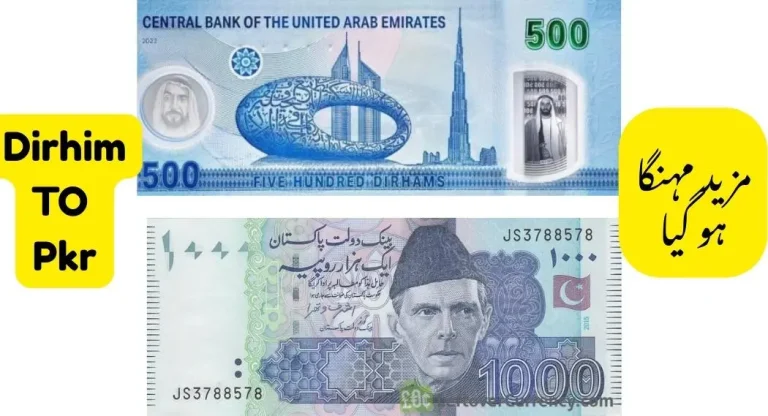
The exchange rate between the UAE Dirham and the Pakistani Rupee plays a vital role in the economic relationship between the two countries. With over 1.5 million Pakistanis working in the UAE, the AED to PKR rate directly affects remittances, trade, and family finances across Pakistan. In 2026, the pair has shown notable stability amid global economic pressures, reflecting the UAE’s fixed currency peg and Pakistan’s improving external accounts. This article provides a detailed, up-to-date overview of the latest rates, historical trends, key influencing factors, and the broader market outlook for the remainder of 2026.


Current Exchange Rate in Mid-April 2026
As of April 15, 2026, the mid-market exchange rate stands at approximately 1 AED = 76.00 PKR. This figure represents the average of buying and selling rates in the global forex market and remains consistent with levels observed throughout the first half of April. Minor daily fluctuations have kept the rate within a tight band of 75.80 to 76.10 PKR per Dirham, indicating low volatility.
Open-market rates in Pakistan, which include bank margins and dealer spreads, typically range slightly higher, often between 75.90 and 76.20 PKR depending on the provider and transaction size. The stability observed in recent weeks stems from steady foreign exchange inflows and the UAE Dirham’s unwavering peg to the US Dollar.
To illustrate recent movements, the following table summarizes daily mid-market rates for selected days in April 2026:


| Date | Opening Rate (PKR) | High (PKR) | Low (PKR) | Closing Rate (PKR) | Daily Change (%) |
|---|---|---|---|---|---|
| April 1, 2026 | 75.91 | 75.91 | 75.91 | 75.98 | +0.08 |
| April 3, 2026 | 75.79 | 75.79 | 75.79 | 75.79 | -0.25 |
| April 7, 2026 | 76.03 | 76.09 | 76.03 | 76.09 | +0.12 |
| April 9, 2026 | 76.08 | 76.08 | 76.08 | 76.08 | +0.00 |
| April 13, 2026 | 75.97 | 76.06 | 75.97 | 76.06 | +0.12 |
| April 14, 2026 | 75.97 | 75.98 | 75.97 | 75.97 | -0.12 |
| April 15, 2026 | 75.98 | 76.00 | 75.98 | 76.00 | +0.04 |
These figures highlight a range-bound pattern with no significant directional bias in the short term.
Historical Performance in 2026
The AED to PKR pair entered 2026 with moderate strength. Year-to-date data through mid-April shows an average rate of around 76.11 PKR per Dirham. The highest level recorded so far was approximately 76.86 PKR in early February, while the lowest touched 75.60 PKR in late January. This represents a narrow trading band of roughly 1.26 PKR, underscoring relative calm compared to more volatile currency pairs.
Compared with 2025, when rates frequently hovered between 76 and 77 PKR, 2026 has seen a slight softening on average. The Pakistani Rupee has benefited from stronger foreign exchange reserves and consistent remittance inflows, helping to offset any pressure from external repayments or global commodity shifts. Overall, the pair has changed by less than 0.5 percent since the start of the year, reflecting structural stability rather than speculative swings.
Key Factors Influencing the AED to PKR Exchange Rate
Several interconnected elements drive movements in the AED to PKR rate. Understanding these provides insight into why the pair has remained steady in 2026.
- UAE Dirham’s Fixed Peg to the US Dollar: Since 1997, the UAE has maintained a firm peg at 3.6725 AED per USD. This policy anchors the Dirham’s value and transmits US monetary policy directly into the AED to PKR equation. Any strengthening or weakening of the USD against the PKR therefore influences the rate predictably.
- Pakistan’s Remittance Inflows: Remittances from the UAE remain a cornerstone of Pakistan’s external account. In February 2026 alone, Pakistani expatriates in the UAE sent nearly 696 million USD, while March contributions reached approximately 824 million USD. These flows, which form part of Pakistan’s total remittances exceeding 30 billion USD in the first nine months of fiscal year 2026, provide consistent demand for PKR and support its value.
- Pakistan’s Macroeconomic Indicators: Foreign exchange reserves, inflation trends, and the current account balance play critical roles. In 2026, Pakistan has managed a near-balanced current account, aided by import compression and export resilience in sectors such as textiles and automobiles. However, scheduled repayments—including a 3.5 billion USD deposit to the UAE—have required careful reserve management.
- Global Oil Prices and UAE Economic Diversification: Although the UAE continues to benefit from energy exports, its growing focus on tourism, technology, and renewable energy reduces direct oil dependency. Stable oil prices in 2026 have indirectly supported the Dirham without introducing sharp volatility.
- Bilateral Trade and Investment Flows: Trade between Pakistan and the UAE, encompassing food products, construction materials, and services, adds to currency demand. Investment commitments and joint projects further reinforce long-term rate stability.
These factors collectively create a self-reinforcing environment where short-term shocks are quickly absorbed.
Pakistan-UAE Economic Relations and Their Impact
The economic partnership between Pakistan and the UAE extends far beyond currency conversion. The UAE ranks among Pakistan’s top sources of remittances and foreign investment. Pakistani workers in the UAE, concentrated in construction, services, and logistics, contribute substantially to household incomes back home. In turn, these inflows help Pakistan maintain foreign exchange reserves above 21 billion USD in early 2026.
Trade volumes have grown steadily, with the UAE importing Pakistani rice, textiles, and leather goods while exporting petroleum products, machinery, and chemicals. Government-to-government initiatives, including infrastructure financing and energy cooperation, add another layer of interdependence. Even amid occasional discussions around loan repayments, the overall relationship has remained constructive, with remittances acting as a reliable buffer.
For Pakistani families, the current rate of around 76 PKR per Dirham translates into meaningful purchasing power. A typical monthly remittance of 2,000 AED, for example, yields approximately 152,000 PKR—enough to cover education, healthcare, and daily expenses for many households.
Market Outlook for the Remainder of 2026
Analysts project continued stability for the AED to PKR pair through the end of 2026. Most forecasts anticipate the rate to trade within a 75.80–77.00 corridor during the second half of the year. Factors supporting this view include sustained remittance growth, expected moderation in global interest rates, and Pakistan’s ongoing engagement with international financial institutions.
Potential upside risks for the PKR include stronger-than-expected export performance or additional foreign investment inflows. Downside risks could emerge from higher global commodity prices or unexpected geopolitical developments in the region. However, the structural anchors—UAE’s currency peg and Pakistan’s remittance lifeline—suggest that any deviations will likely remain modest.
Longer-term projections point to gradual convergence around 75.80–76.50 PKR per Dirham by year-end, assuming no major policy shifts in either country. This outlook aligns with broader expectations of moderate PKR depreciation against the USD, tempered by the AED’s own stability.
Practical Considerations for Individuals and Businesses
For those converting AED to PKR—whether expatriates sending money home or businesses handling trade payments—timing remains important despite overall stability. Banks and authorized exchange companies often offer competitive rates for larger transfers, while digital platforms provide convenience for smaller amounts. Monitoring weekly trends and comparing rates across providers can help maximize value without exposing users to unnecessary risk.
In summary, the AED to PKR exchange rate in 2026 exemplifies resilience in an otherwise uncertain global environment. With the rate holding steady near 76.00 PKR per Dirham in mid-April, supported by strong fundamentals on both sides, the pair is well-positioned to serve as a dependable bridge between the UAE and Pakistan economies. As the year progresses, continued focus on remittances, trade diversification, and prudent fiscal management will likely preserve this equilibrium, benefiting millions of families and businesses linked across the two nations.